Mold Removal in Covington, LA
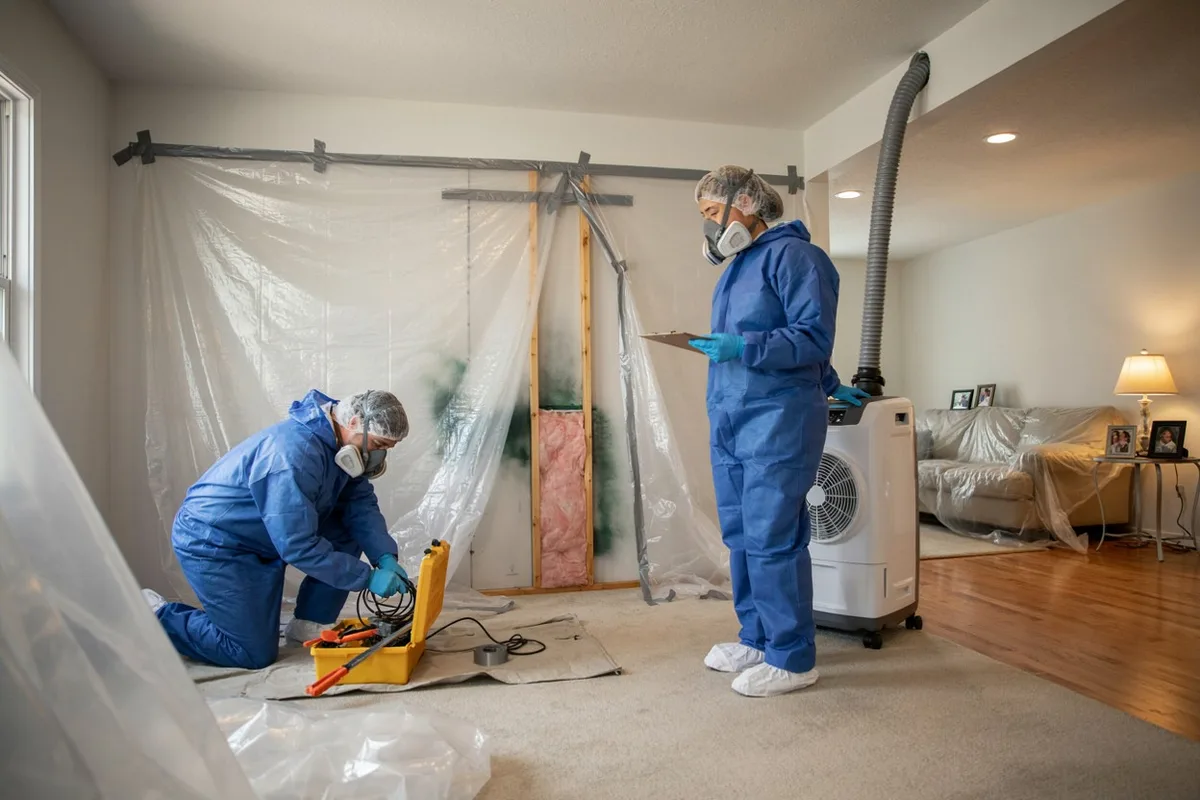
You slid the bookcase off the outside wall of the bedroom and the paint behind it is speckled. Or the ceiling below the upstairs laundry has a stain that has changed shape twice. Or the pantry wall that backs up to the air handler closet has gone soft at the bottom. Modern home. Louisiana humidity. Call and describe what you’re seeing — we remove mold in Covington, Mandeville, and the Northshore, and that is all we do.
What we do first
We start with the room, the material that’s stained, and where the water is coming from. Moisture readings on the drywall and the framing behind it set the edges of the job: which sheets come out, which studs get cleaned, how far past the stain the wet area actually runs. The stain may not show the whole problem.
Then the work area gets sealed in plastic and put under negative pressure so nothing travels through the rest of the house. We wear respirators and suits, and so does anyone working alongside us.

Where EPA says mold hides, and what we do about it
- EPA lists the common hiding places: the back of drywall and wallpaper, the underside of carpet and pad, around pipes inside walls, above ceiling tiles, inside ducts.
- Drywall, insulation, carpet pad, and anything else porous that has been wet and moldy comes out, bagged inside the containment before it leaves.
- Framing, masonry, and slab stay and get cleaned in place, then HEPA-vacuumed and wiped down.
- Nothing gets closed until the wood reads dry — dead mold is still an allergen, so the goal is removal, not killing.
Tell Us What Got Wet, 24/7
The water has to stop first
Mold needs moisture. Louisiana supplies plenty. If the leak that fed the growth is still running, the removal won’t hold, so part of every job is finding where the water came from and telling you what has to change. EPA doesn’t recommend bleach as a routine practice and says never to paint or caulk over mold; bleach isn’t a remediation plan, and a fresh coat changes the color, not the cause.
Covington and Mandeville notes
Most of the houses we work in here were built after 2005, in subdivisions off Highway 21, 1085, and 1088 that were laid out tight and cooled year-round. Those houses hide water well. A supply line behind a refrigerator, a window that leaks in a north wind, a drain line off the attic air handler — any of them can run for a season with nothing showing but a smell. The older cottages in Old Mandeville and along the rivers show it faster, in a soft baseboard or a smell through the floor. Either way, yesterday’s leak is today’s removal.
What you get when it’s done
A written report of what came out, from where, and why. Louisiana law requires a remediator to give you one, and it is the document a buyer, a tenant, or an adjuster will ask to see.